
The End of the Sponsored Row: Why Paid Placement Is Broken
You already know which row to skip.
The End of the Sponsored Row Why Paid Placement Is Broken
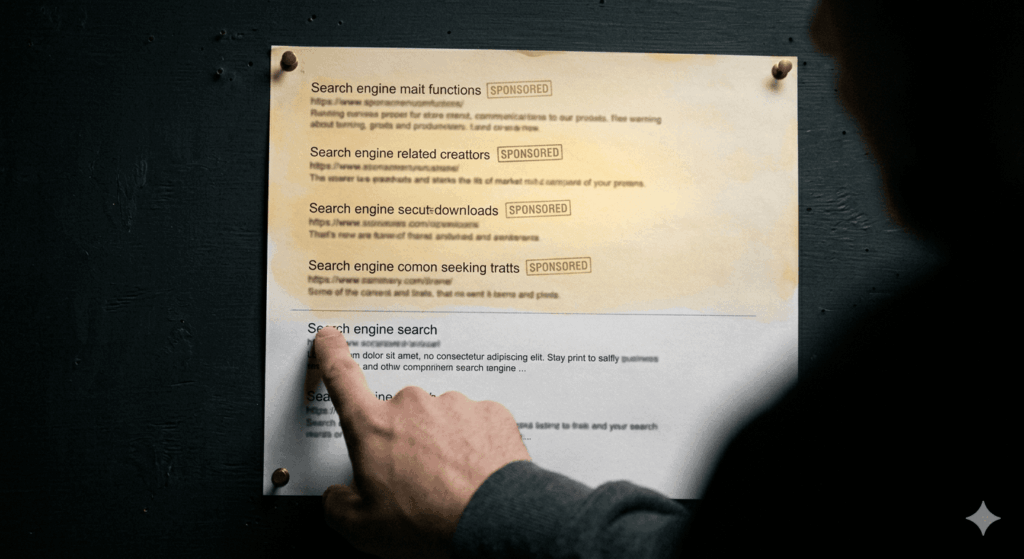
You open a marketplace, type what you’re looking for, and the first four results are marked “Sponsored.” You scroll straight past them. Not because the products are necessarily bad, but because you know they’re there for a reason that has nothing to do with being the best answer to your search. They’re there because someone paid to put them there.
This has become so normal that most shoppers don’t even register it any more. It’s just the thing you scroll past before the real results begin. But the fact that we’ve all accepted it doesn’t mean it isn’t broken. It is — and it’s worth understanding exactly how, and why it matters.
What Sponsored Listings Actually Are
Sponsored listings are paid placements. A seller pays a platform — Amazon, eBay, Google Shopping, take your pick — to have their product appear at the top of search results for a given keyword. The more competitive the keyword, the more expensive the placement. The more they pay, the more visible they are.
The platforms present this as advertising, which is technically accurate. But in practice, it functions as something more corrosive than advertising: it turns the search results page into a pay-to-win environment where visibility is determined by budget, not merit.
The product at the top of the page is not the best product for your search. It is the product whose seller spent the most to be there. Those are not the same thing — and the gap between them is where shoppers consistently get shortchanged.
💡 Follow the Money
Amazon’s advertising revenue exceeded $46 billion in 2023. That money comes directly from sellers competing for visibility on the platform. The more sellers spend on sponsored placements, the higher their costs — and those costs get passed on in product pricing. Shoppers pay twice: once in inflated prices, once in degraded search results.
What It Does to Independent Sellers
The sponsored listing model is particularly damaging to smaller, independent sellers — the exact businesses that ecommerce was supposed to empower.
A large brand with a substantial advertising budget can dominate search results for any keyword it chooses, regardless of whether its product is better than the alternatives. A small seller with a genuinely superior product but a limited budget gets buried on page three. The platform, which presents itself as a level playing field, is in reality a tiered system where the biggest wallets win.
This creates a feedback loop that’s difficult to escape. Small sellers spend on sponsored placements to get visibility. The increased cost of customer acquisition reduces their margin. Reduced margin limits their ability to invest in the product. A worse product gets less organic traction. They spend more on sponsored placements. Repeat.
Meanwhile, the platform collects advertising revenue from every participant in this cycle — regardless of who wins or loses.
“The best product and the top result are no longer the same thing. That’s not a small problem. That’s a fundamental failure of what search is supposed to do.”— Justin Hodnett, Founder, ShopWithMore
The Discovery Problem Nobody Talks About
Beyond the fairness argument, there’s a practical problem for shoppers that gets less attention: sponsored placements have made product discovery significantly worse.
Discovery — finding something you didn’t know you were looking for, or finding the genuinely best version of something you were looking for — depends on results that are ranked by relevance and quality. The moment you introduce paid placement, you corrupt that ranking. The signal becomes noise.
Shoppers have adapted by developing what might be called sponsored blindness — an automatic tendency to skip the top results and start reading from wherever the organic listings begin. This is rational behaviour in response to a broken system. But it means the entire top section of most search results pages is now effectively wasted space that shoppers have learned to distrust.
A search experience that has trained its own users not to trust the first thing they see has a fundamental problem.
No Sponsored Row. No Paid Placement. Ever.
ShopWithMore doesn’t have a sponsored row. There is no mechanism for a seller to pay for visibility. There is no budget that buys a better position in search results.
Products surface based on relevance to what the shopper is actually looking for. That’s it. When we build out our AI-powered discovery in V2, the ranking signal will be even more sophisticated — based on understanding shopper intent rather than just keyword matching — but the principle will remain identical. The result you see first is there because it’s the best match for your need. Not because someone paid for the slot.
We think this is simply how ecommerce should work. We’re aware that it means leaving advertising revenue on the table. We’ve made that trade deliberately, because a platform that shoppers can trust to show them unbiased results is worth more in the long run than one that doesn’t.
The sponsored row’s days are numbered. Not because platforms will voluntarily give up the revenue — they won’t. But because shoppers are increasingly aware of what it costs them, and alternatives are emerging that don’t ask them to pay that price.
See what unbiased product discovery looks like at shopwithmore.co.uk.

About The Author
