
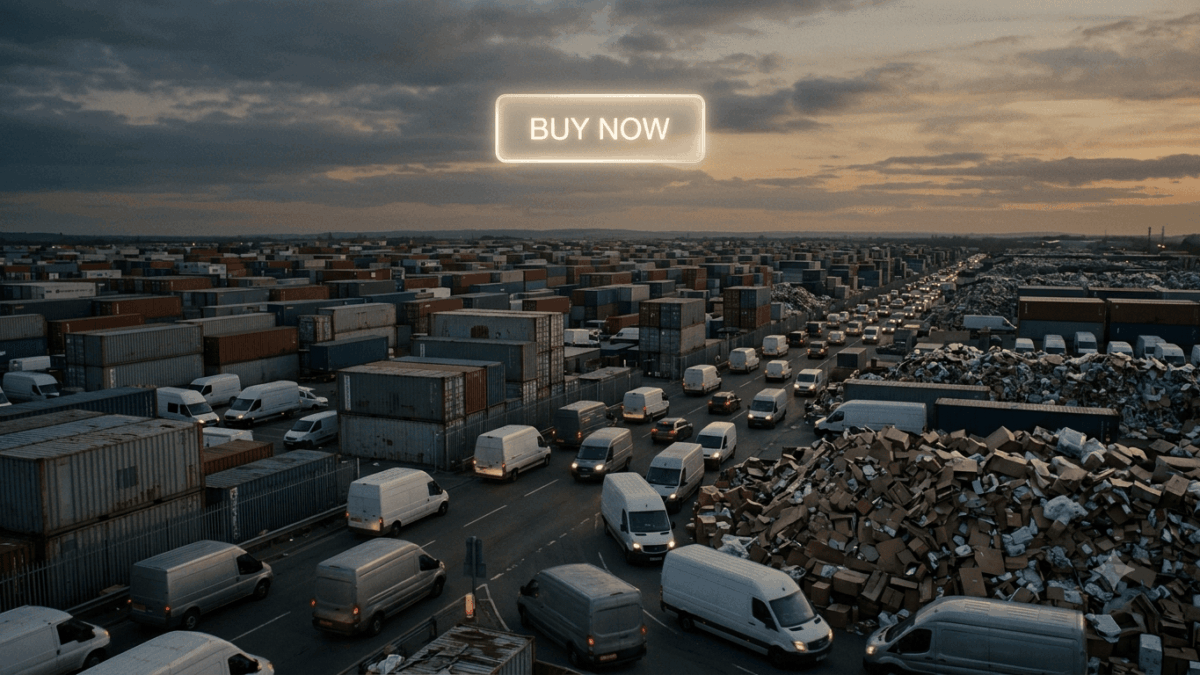
The convenience of one-click purchasing was built to remove friction. Nobody designed it to make you think about where the item actually ends up.
Speed removes the moment of consideration
When there’s a delay between wanting something and receiving it, people naturally reconsider. Overnight, a day, a few days of shipping time used to create a small window for second thoughts — do I actually need this, will I actually use it, is this the right one. One-click purchasing and same-day delivery collapse that window almost entirely. The environmental cost of that isn’t abstract. Faster fulfilment generally means smaller, more frequent shipments, more individual delivery trips, less consolidation, and significantly higher carbon cost per item delivered compared to slower, batched logistics.
The return is often worse than the purchase
Impulse purchases have a meaningfully higher return rate than considered ones — people buy quickly, then reconsider once the item physically arrives. But a return isn’t a simple reversal. The item travels back through the supply chain, often to a returns centre rather than directly back to stock, sometimes to be inspected, repackaged, or in a significant number of cases, disposed of entirely because reprocessing costs more than the item is worth. Fast fashion in particular has faced scrutiny for returned garments being sent to landfill or incineration rather than resold, simply because the economics of resale don’t justify the labour cost of inspection and restocking.
The convenience that got you the item quickly is the same convenience that makes disposing of it, if you change your mind, disturbingly frictionless too.
Packaging scales with speed, not need
Fast, individual fulfilment tends to generate more packaging per item, not less. Products that could be consolidated into a single shipment if ordered together arrive separately when ordered impulsively across different moments, each with its own box, its own void fill, its own delivery trip. The environmental cost isn’t just the product — it’s the multiplying effect of treating every purchase as an isolated, urgent event rather than part of a considered whole.
What this doesn’t mean
None of this is an argument against convenience, or a case for making online shopping deliberately slower and more difficult. People’s time and needs are genuinely legitimate, and friction for its own sake helps nobody.
It’s simply worth naming what the convenience actually costs, because it’s a cost that’s been made almost entirely invisible by design. The one-click button doesn’t show you the delivery van’s route, the packaging waste, or the returns centre. It shows you a product and a price. The rest of the picture matters too — and platforms that care about that picture, rather than just optimising the click, will end up building something more genuinely sustainable in the long run.